
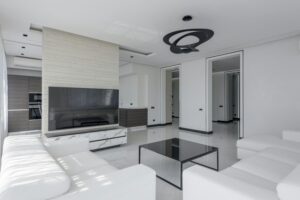
When my parents renovated our house in the early 2000s. We just hired a contractor, gave him a budget, and hoped for the best. It was… okay. Nothing special. My mom wanted better, but honestly, where would you even find someone who could do that back then? There was nobody doing serious interior design work in Delhi. The concept of Luxury Interior Designers in Delhi simply didn’t exist. You couldn’t Google it. You couldn’t find someone who understood space, light, materials, and human behavior the way these professionals do today. It just wasn’t a thing.
Fast forward to now, and it’s wild how much has changed. I started noticing it around 2015 or so. Friends would invite me to their homes, and I’d walk in thinking it would be the usual—nice enough, expensive things scattered around, maybe some decent furniture. But then their kitchen would blow me away.
Or their bedroom would have this perfect lighting setup that made the space feel twice as big as it actually was. Or a living room would flow so naturally that you didn’t realize you were walking through a thoughtfully designed space.
That’s when I started asking questions. Who did this? How much did it cost? And that’s when I discovered there’s this entire world of Luxury Interior Designers in Delhi that most people don’t know about unless they need them.
Getting to Know the Designers Actually Working in Delhi
I started meeting these designers at parties and through mutual friends. The first thing I noticed was that they weren’t like the decorators of my parents’ generation. These people talked about spatial flow, natural light patterns, how materials age over time, the psychology of colors.
One designer spent twenty minutes explaining why she’d chosen a specific shade of off-white for a wall—it had to do with how the sunlight hit it at different times of day, how it would interact with the furniture, what feeling it would create.
I met this designer named Priya through a friend whose apartment was featured in some design magazine. I asked her what made her different from just hiring an interior decorator, and she said something I’ll never forget: “A decorator puts pretty things in a room. A designer understands how humans live, and creates spaces that work for them.” That stuck with me.
When I started looking at actual projects these Interior Designers in Delhi were creating, I became genuinely obsessed. Not in a crazy way, but I’d ask to visit homes, take photos, understand the thinking behind design decisions. I started following designers on Instagram, reading about their projects, understanding what separated good work from exceptional work.
One thing I realized early on: most of these designers learned their craft outside India. They’d gone to design schools in Europe or the US, worked with international firms, and then came back to Delhi with all this knowledge and fresh perspective. They brought standards that didn’t exist in the Indian market before.
Suddenly, clients had someone who could explain why they shouldn’t use glossy tiles in a small kitchen, or why the placement of a sofa actually matters for how the light hits your face when you’re sitting.
What I’ve Learned Spending Time in These Homes
I’ve probably walked through at least eighty to ninety beautifully designed homes across Delhi now. Some in sprawling bungalows in Lutyens, some in cramped apartments in Dwarka, some in massive penthouses in Aerocity. And you know what I’ve discovered? There’s a massive difference between a home that just looks nice and a home that’s actually been designed.
The homes that truly impress me—the ones where you walk in and just feel this sense of “wow”—they all have something in common. The first thing is that nothing feels forced. The design isn’t screaming at you. Your eye naturally moves through the space. The colors work together even though you can’t necessarily put your finger on why.
The furniture is arranged in a way that makes sense for how people actually move through the room and use it.
I visited this gorgeous three-bedroom home in Greater Kailash recently. The entrance was simple—just a hallway with white walls and wooden flooring. But the way the light came in through a skylight, the way the hallway opened into a living area without feeling abrupt, the way you could naturally see where to go next—that was all intentional. None of it was accidental. The designer had thought about every single transition.
The second thing I’ve noticed is that the best homes have this quality of being lived in. They’re not sterile. They’re not magazine-perfect in a way that makes you uncomfortable to sit on the furniture. A family lives there. Kids play there. People cook and eat and argue and laugh and relax there. But somehow, the design is so good that even with real life happening in the space, it still looks beautiful.
I was at my cousin’s place last year. Her designer had created this open kitchen and living area concept that’s absolutely stunning. One Sunday afternoon, my cousin was cooking, her husband was helping, their kids were doing homework at the kitchen island, and I was sitting on the sofa reading. Everyone had their own activity, but it all felt connected. The space facilitated that. It brought people together while also giving them space. That’s not luck. That’s design.
The Kitchen Revolution—Modular Kitchens in Delhi Changed Everything
You know what surprised me the most when I started looking at these projects? Kitchens became the most important room. I don’t mean the most expensive or the fanciest. I mean actually the most important, the most thoughtfully designed, the heart of the home.
When I was growing up, kitchens were hidden. My mom would cook, and we’d eat in the dining room. The kitchen was utilitarian—you got in, you cooked, you got out. Now? Now the kitchen is where everything happens. I go to dinner parties and people are mingling around the kitchen island while someone’s cooking. Kids do homework there. Families have breakfast there. People work from there now.
Modular Kitchens in Delhi have become this art form. I remember asking a designer friend what the difference was between a modular kitchen from a showroom and one she designed. She took me to see one she’d done. The modular aspect just meant the components were standardized, but everything else—the layout, the materials, the finishes, the hardware—was completely custom.
The kitchen she showed me had Italian cabinets (which she explained have better hinges and closer tolerances than Indian ones), Rajasthani granite countertops chosen specifically for the sunlight in that apartment, a backsplash that tied the whole color palette together, and lighting designed so that you could actually see what you were cutting without shadows from your own body blocking the light.
But what really impressed me was the functionality. The person who cooked in that kitchen had mentioned they made fresh pasta sometimes, so there was a dedicated counter space just for that. They liked baking, so the oven was positioned at a comfortable height and there was an adjacent counter for cooling things.
They entertained often, so the island was large enough for guests to sit while the cooking happened. The refrigerator was positioned so you could see into the living room while grabbing something to drink. These were real decisions based on how actual people actually live.
I’ve been in multiple kitchens now where the design was all aesthetic and barely functional. One had beautiful Italian cabinets but the drawer organization was a nightmare. Another had this stunning backsplash but the appliances were positioned in a way that made cooking awkward. These aren’t successful designs. A successful kitchen is beautiful AND works perfectly for the people using it.
Exploring Different Delhi Neighborhoods and Their Design Personalities
Delhi’s so big and so diverse that the design challenges in different areas are completely different. This fascinated me because it meant designers had to really understand their neighborhood, not just impose some generic luxury aesthetic.
In the older parts of Delhi—like Lutyens Delhi with all those heritage bungalows—the designers I met had to work with existing structures. High ceilings, architectural details, room sizes that don’t match modern living. One designer told me she spent weeks just studying how light moved through a house throughout the day before she made any design decisions.
In old bungalows, the light is different at every hour because of the way the architecture was built. You can’t just ignore that and slap paint on walls.
Greater Kailash has these beautiful tree-lined streets and houses with courtyards. The designers working there told me they’re always trying to connect the inside and outside. Large sliding doors, covered loggias, outdoor spaces that feel like extensions of the living area. It rains in Delhi, it gets hot, but the design there is about blurring the line between indoor and outdoor living.
South Delhi in general has more spacious homes than you get elsewhere. So designers there have different challenges—how do you make a large space feel intimate? How do you create different zones without walls? How do you use color and furniture arrangement to make a sprawling area feel coherent?
What’s Happening in Best Interior Designers in Dwarka Delhi
Honestly, two years ago, if someone had said “Let’s go look at beautifully designed homes in Dwarka,” I would’ve laughed. Dwarka always felt corporate and new and kind of soulless. I had this prejudice that real design, serious design, couldn’t happen in a place like that.
I went to visit a project in Dwarka because my friend’s colleague had their apartment designed there, and I wanted to see what it looked like. Walking into that home, I was shocked. It was genuinely beautiful. Not in a flashy way—just genuinely well-designed.
The apartment wasn’t huge. It was a standard three-bedroom in a modern building. But someone who knew what they were doing had maximized every bit of space. The colors were chosen so the apartment felt bigger.
The storage was invisible—you’d open a wall and find cabinets. The lighting made the space feel warm despite the somewhat cold modern architecture of the building. Every material chosen was something that would age well and look good for years.
I started asking around and realized there are actually some really talented Best Interior Designers in Dwarka Delhi working there now. And what’s interesting is that they’re working with constraints. Dwarka apartments aren’t cheap, but they’re not sprawling penthouses either. So the designers there have to be cleverer.
They can’t just throw expensive materials at a problem. They have to actually understand design fundamentals—space, light, color, proportion, material selection.
I met one designer who was working on a Dwarka project, and she was explaining her color palette to the clients. She’d chosen this warm cream for the walls because the apartment faced north and didn’t get direct sunlight for much of the day. The warm tone would compensate for that. Furniture was planned to be light-colored to make the space feel more open.
Accent pieces in deeper tones would add visual interest without darkening the space. She showed them mood boards and explained her reasoning for everything.
That’s what impressed me—not the budget or the fancy materials, but the actual design thinking. Any designer could spend ₹50 lakhs on a kitchen. Can they create a beautiful, functional, smart space within a realistic budget? That’s where you see the real skill.
Details Actually Separate Good From Exceptional
I’ve been invited to enough homes now that I can actually feel the difference when I walk into a well-designed space versus a poorly designed one. It’s like your body knows before your conscious mind catches up.
You feel more relaxed. The space doesn’t give you cognitive dissonance.
One home I visited had mismatched styles—modern furniture, traditional wall colors, contemporary art, old rugs. It was chaos. My eyes didn’t know where to land. I felt unsettled. I didn’t want to stay there long.
Another home had a very clear aesthetic. Everything worked together. The furniture reflected the same design sensibility as the walls, the art, the accessories, the flooring.
You walked in and there was a sense of coherence. Even though it was a complex design with multiple elements, it felt calm.
I’ve learned that this isn’t snobbery. It’s neuroscience. Our brains are designed to find patterns and coherence. When a space is well-designed, your brain relaxes because everything makes sense. When a space is poorly designed, your brain is constantly confused about what it’s looking at.
Another thing—the lighting. Oh man, the lighting. I went to my friend’s apartment after she’d had it redesigned, and the first thing I noticed wasn’t the furniture or the paint or anything I could have predicted.
It was how she looked. The lighting was so flattering that she looked better than I’d ever seen her look.
Not in a makeup way, but in an “I have good natural-looking light on my face” way.
She explained that the designer had spent hours figuring out where the light sources should be, what color temperature they should be, how they’d interact with the wall colors and furniture.
I tested this theory at other homes. In one apartment, the lighting was harsh and made everyone look tired. In another, it was perfectly warm and made everything look inviting.
The difference was massive. And honestly, you don’t notice it consciously until someone points it out, but once you notice, you can’t unsee it.
Why People Are Actually Investing in This
I’ve talked to enough people now to understand that spending real money on getting a designer is not frivolous. It’s an investment in your daily quality of life. You spend more time in your home than in your office. If your home is poorly designed, you’re spending thousands of hours somewhere that frustrates you or doesn’t serve you well.
One friend spent ₹15 lakhs on her kitchen design—not including appliances, just the design and execution. I asked if she regretted it. She said, “I cook almost every day. I’ve used this kitchen for five years now. Do the math. That’s 1,800 days of using a space that works perfectly for me. It was worth every rupee.”
Another friend hired a designer to help with her entire apartment layout. The design fee was significant, but she said the designer prevented her from making several expensive mistakes. She was about to buy a sofa that would have blocked the natural light. The designer suggested a different layout that would work better.
She was planning to paint everything white, but the designer suggested a warm neutral that made the space feel more alive. Small decisions, but they would’ve cost more to fix later.
I think people are also realizing that a well-designed home holds its value better. If you ever rent it out, tenants pay more for a well-designed space. If you sell it, buyers appreciate good design even if they’re going to change it. And more importantly, if you just live there, you enjoy it more.
The Real Reason These Spaces Matter
Spending time in beautifully designed homes changed how I think about space. I realized that where you live actually shapes who you are. A home that’s chaotic and poorly designed creates stress and frustration. A home that’s well-designed creates calm and actually makes you a better version of yourself.
I have friends who used to never cook at home, and once their kitchens were redesigned properly, they started cooking regularly because it became enjoyable.
I met this woman who was depressed, and after she got her home redesigned by one of the talented Interior Designers in Delhi, she said the most interesting thing. She wasn’t depressed anymore. Not because of some magical design intervention, but because she was spending time in a beautiful space that worked perfectly for her, and that changed her daily experience of life.
The designer had spent weeks understanding her lifestyle, her daily routines, and what would make her space feel nurturing. She’d wake up and her bedroom would be flooded with light at exactly the right time. These small daily experiences added up, and she credited the Interior Designers in Delhi for understanding that good design isn’t just about aesthetics—it’s about creating an environment that supports your wellbeing.
That’s when I really understood what Luxury Interior Designers in Delhi do. It’s not about luxury in the sense of expensive. That’s what makes them genuinely beautiful.